Pyrenees Shire · Wadawurrung Country
Snake Valley
A gold town of 1857 on the road from Linton to Carngham, west of Ballarat: 820 people in and around it at the last census. Its story from the record, and what is here today.
Fig. 1
Nimbuck, Carngham, Snake Valley
From the public record: the newspapers on Trove, the heritage listings, the Department of Education’s school history. Where the sources disagree, the page says so. The year beside each part is the year it turns on. The Snake Valley & District Historical Society, in the rooms on the old court house site, keeps the district’s own records and knows a great deal more than this page.
Before 1837
Wadawurrung Country
Snake Valley and Carngham are on Wadawurrung Country, the country of the Carringum balug clan. In the Wadawurrung Traditional Owners Aboriginal Corporation’s own words: “We acknowledge that our Ancestors nurtured and cared for Wadawurrung Country for tens of thousands of years.”
Wikipedia gives the valley’s name as Nimbuck or Nimlock, and the shire’s 2019 plan as Nimbuck or Nimluck. Neither says where it comes from. Anything more is theirs to say.
From Wadawurrung Traditional Owners Aboriginal Corporation, Victorian Places, Snake Valley, Wikipedia, Snake Valley, Victoria and Pyrenees Shire Council, Safer and more resilient Pyrenees Communities: Snake Valley (2019).
1840
Carngham station
Carngham is older than the gold. J. D. Baillie was writing from “Carngham, near Buninyong” in 1840, and in March 1843 Philip Russell and his cousin bought the station and 3,500 sheep from him. (Victorian Places says the run was taken up in 1838; the Heritage Council says 1839.) Carngham was Russell’s home until he died in 1892, and his family’s until 1979.
A traveller came through in 1853: “Carngham is a township on this road. It consists of two or three huts, a small store, and a fine hotel… It seems to be a dull place.”
From the Port Phillip Gazette, 9 September 1840, the Victorian Heritage Database, Carngham Memorial Church (H2427), Victorian Places, Carngham and the Argus, 31 March 1853.
1857
A large gully called Snake Valley
Gold was found at Carngham in 1855. In October 1857 the Star reported “a new rush… in a large gully called Snake Valley”, two miles up the creek from Carngham, where Duncan and his mates were washing up to three-quarters of an ounce from four buckets. Nearly five hundred miners were already on the ground, and “stores and grog shanties are already in any quantity”.
A month later the Star’s reporter found bread at 1s 6d and butter at 2s, and “groggeries, bagatelleries, bakeries, boot and shoeries” along the road from Linton’s. He put the diggers at no more than 5,000. The Ballarat Times, a week later, said “fully seven thousand… a thousand of whom are Chinese”. After the rain the valley was “more like a lagoon than a flat”.
From Victorian Places, Carngham, the Star, 22 October 1857, the Star, 23 November 1857, the Border Post, 5 December 1857 and the Mount Ararat Advertiser, 27 November 1857.
1858
The gold is the property of the miners
Most of the rush was on Philip Russell’s freehold, and he charged for it: a few shillings to break the sod, and a pound more if the hole proved golden. (The papers give 5s and 6s.) On 1 December 1857 about 1,500 diggers met in the valley and resolved that six shillings a claim was enough, “considering that the gold is the property of the miners”. Russell would not deal until £400 in arrears was paid, posted notices against any mining on his land, and had diggers summonsed for trespass. The diggers took up a collection for their defence.
In May 1858 a second rush broke out two miles further up the valley, near Linton’s Hard Hills, and the diggers were “glad… to breath the fresh air on government land once more… where the lordly squatter holds no sway”.
From the Star, 3 December 1857, the Star, 11 December 1857, the Star, 23 November 1857 and the Star, 13 May 1858.
1859
The lead and the reef
Under the shallow ground ran a deep lead, which “takes its rise in Linton’s Hard Hills” and runs north. By September 1859 it was leased claim by claim: the Ancient Briton, the Prince of Wales, the Great Britain, the Sherwood, the Red Lion, the Bedfordshire and the Rob Roy. The Prince of Wales already had a whim and a puddling machine, and between June 1869 and May 1870 it took out 10,636 ounces. Its mullock heaps and three horse puddlers are still in the paddocks at the south end of the lead.
At Carngham the Britannia company found a quartz reef in October 1860 and began crushing in July 1861. The diggers thinned out fast. In July 1859 the mining surveyor counted 870 for “Carngham, Snake Valley &c”, 70 of them Chinese. Carngham had 1,693 people in 1871, 611 in 1881 and 126 in 1891.
On the plan: 1, The Prince of Wales; 2, The Great Britain and the Sherwood; 3, The Red Lion.
Fig. 2
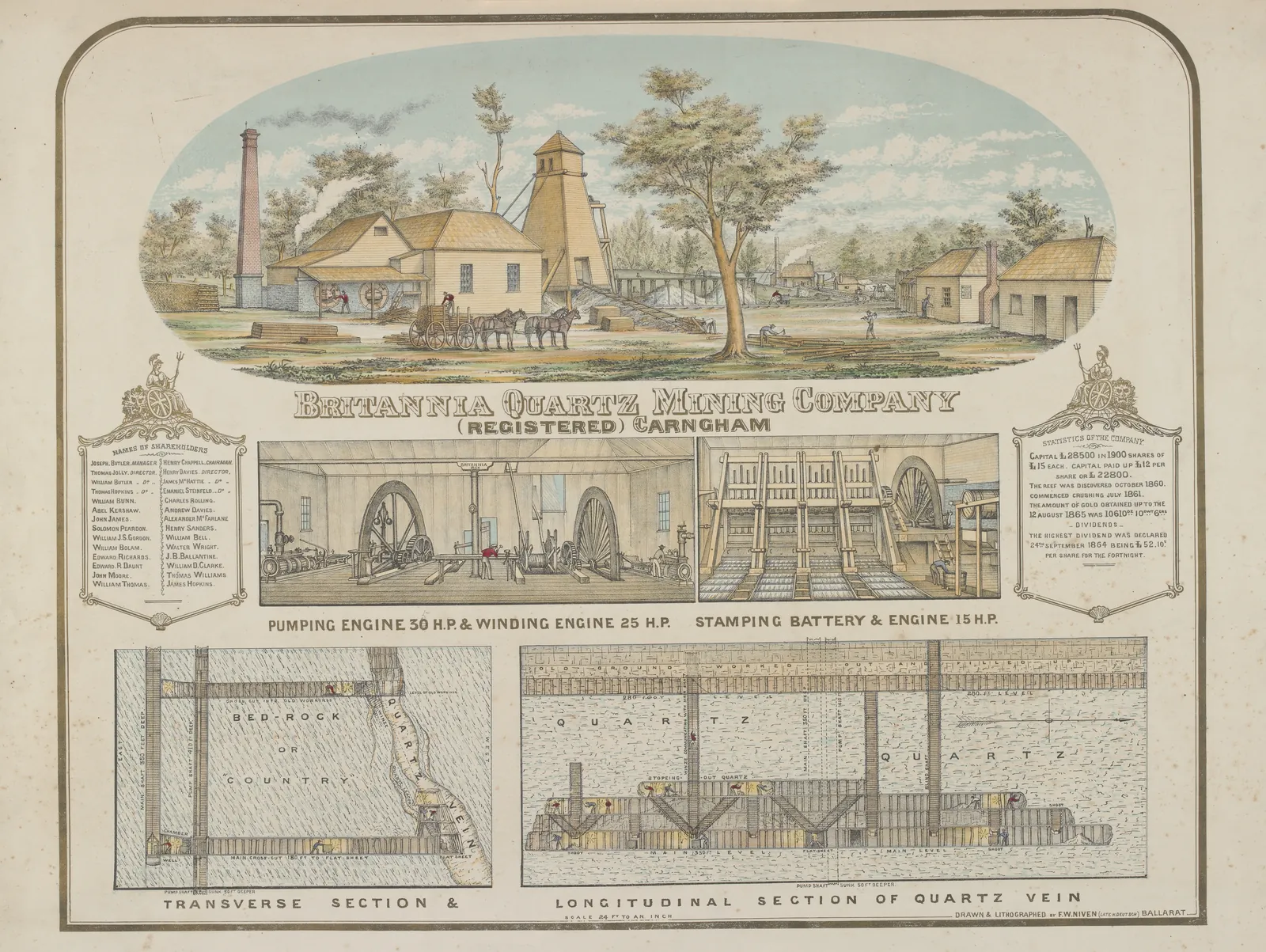
The Britannia Quartz Mining Company at Carngham, about 1864, as it advertised itself: its reef found in October 1860, crushing from July 1861. State Library Victoria, H6866 From the Argus, 23 September 1859, the Heritage Inventory, Prince of Wales Company, the Britannia company’s own printed sheet (State Library Victoria, H6866), the Argus, 19 July 1859 and Victorian Places, Carngham.
1861
“Pull me up, the shaft is closing”
At about two in the morning of 21 March 1861 the Britannia’s shaft fell in on the night shift. Somebody in a hut near the shaft heard cries, ran out, and found one of the four, Mathew Eistock, climbing the rope and calling “For the love of God pull me up, the shaft is closing”. Before they could reach the whim, the whim-ring and the earth went in on all four. Nobody had been left on top. “A grosser case of neglect and mismanagement has seldom if ever occurred on any claim.”
Ebenezer Jones was found on 6 April, one hand still on the rope and his legs crossed round it, “as if he had been climbing up”. He was twenty-nine, from Neath in South Wales, married with one child, and a shareholder knew him “by his dress and ear-rings”. The mine went on under other names: Prince Alfred, New Britannia, Western Star, Britannia Eclipse, and last of all, in 1935, the Carngham Star.
On the plan: 4, The Britannia.
Fig. 3
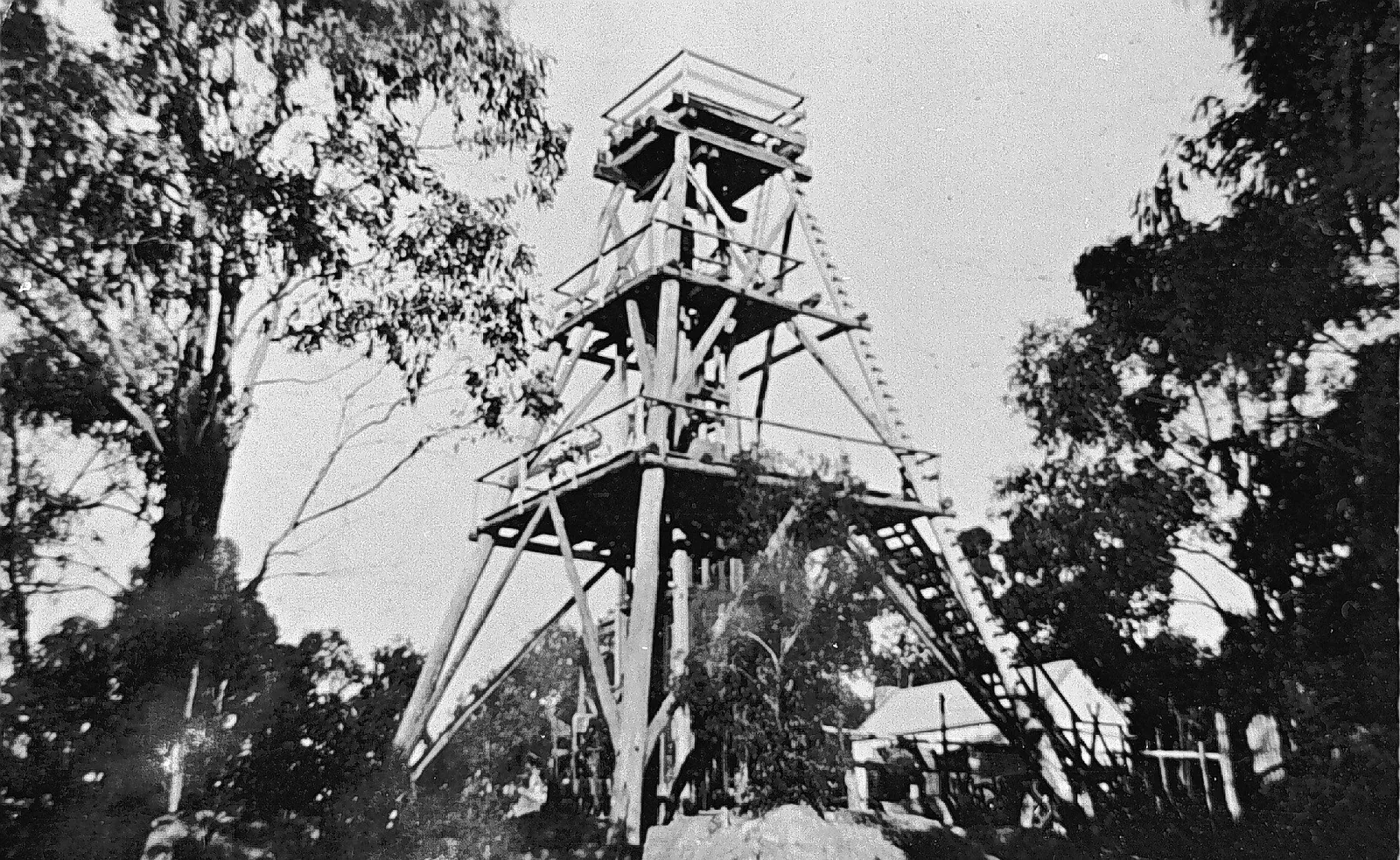
The poppet head of the Carngham Star, some time before 1940: the Britannia’s ground under its last name. Museums Victoria, MM 692 From the Geelong Advertiser, 23 March 1861, the Star, 9 April 1861 and the Heritage Inventory, Britannia Company.
1864
Boxing Day in Russell’s paddock
From 1864 the district kept Boxing Day with a fête in Philip Russell’s paddock for the widows’ and orphans’ fund. In 1866 a thousand adults and about seven hundred children came, behind the Scarsdale brass band of nine instruments. It was still going in 1918, as sports on the recreation reserve for the patriotic funds.
The school, No. 574, had opened on 1 April 1854, three years before the rush, most likely at Carngham rather than in the gully. It had 197 pupils by 1866. Daniel Jones kept another school at Snake Valley from about 1860, and at its tenth annual treat, in 1870, sixty sat down to tea and the boys chased “a strong and nimble calf with a greasy tail”. In 1864 a Daniel Jones of Snake Valley won the Castlemaine eisteddfod’s prize for putting Welsh triads into English. That he was the schoolmaster is likely, not certain.
On the plan: 5, The school.
Fig. 4
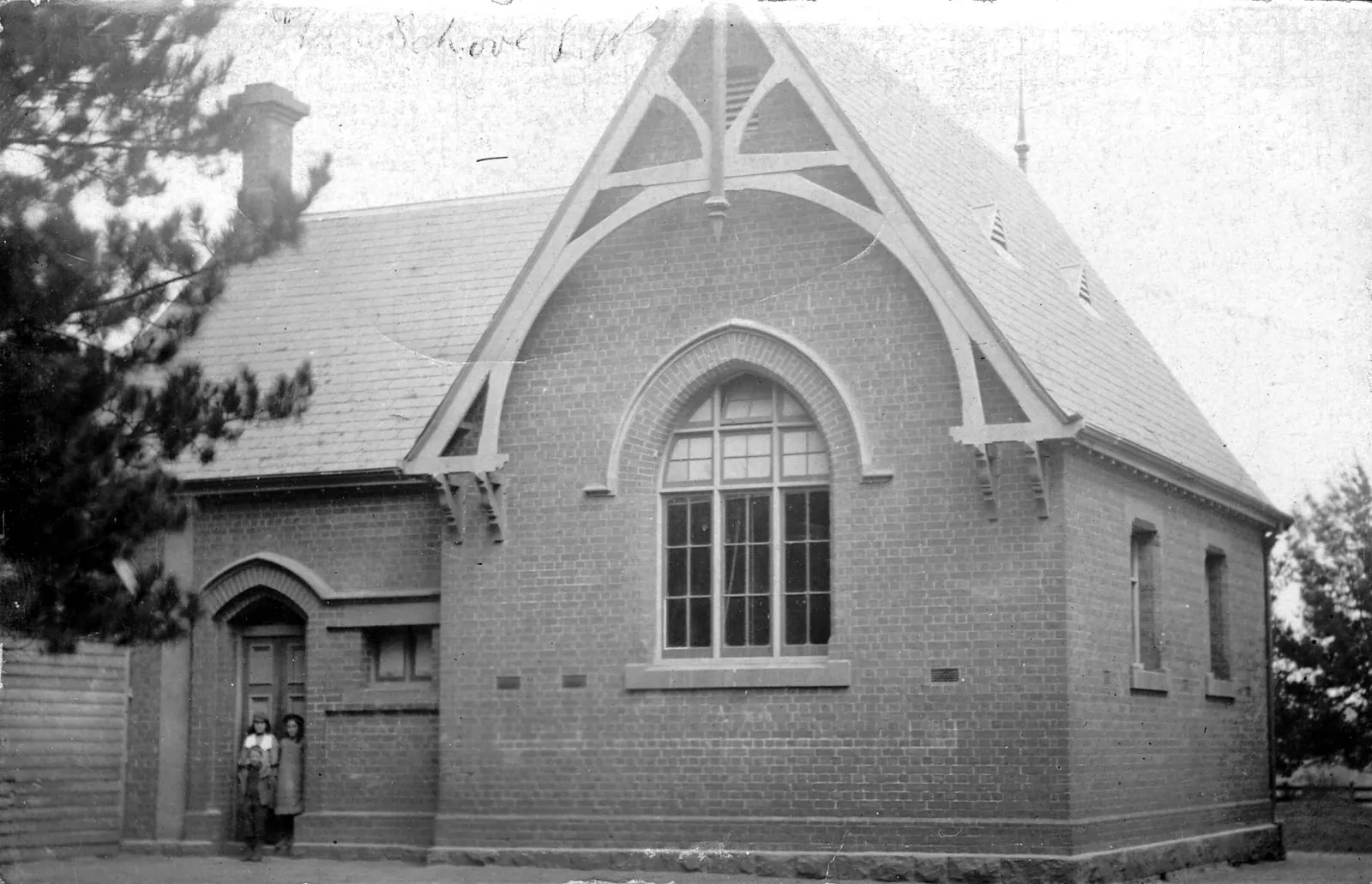
The State school, about 1914, three children at its door. State Library Victoria, H96.106/17 From the Ballarat Star, 28 December 1866, the Ballarat Star, 8 December 1868, the Ballarat Courier, 3 January 1918, the Department of Education, Snake Valley Primary School No. 574, the Ballarat Star, 27 December 1870 and the Mount Alexander Mail, 28 December 1864.
1865
The Chinese miners
There were Chinese on the Carngham diggings before the rush. In February 1857 some Englishmen drove three feet into a Chinese claim, about a hundred Chinese gathered and twenty English, and in the scuffle a man named Aghce was struck on the head and killed. The inquest could not say by whom.
In December 1865 the Kossuth Company brought Chinese miners from Ballarat and dismissed some of its oldest hands to make room for them, and there was talk of a strike. At three one morning in May 1866 its engine house burned down. The manager told the inquest that the Chinese had been paid in full and the old company’s men had not. The jury named him as the man who set the fire, and in July the circuit court acquitted him.
In 1879 Ah Cow, a man of over sixty, was beaten by young men roving the paddocks near his hut. Where the Chinese lived at Snake Valley, and what became of Ah Cow, is not recorded.
From the Argus, 24 February 1857, the Leader, 16 December 1865, the Ballarat Star, 4 June 1866, the Ballarat Star, 20 July 1866 and the Argus, 19 February 1879.
1875
Churches from bequests
On 29 June 1875 about 250 people watched Archdeacon Stretch lay the stone of Holy Trinity, on the main street, with a silver trowel. A bottle holding that day’s Star and Courier went into the cavity, and the party lunched at the Man of Kent. The church was in use by 1877.
Philip Russell’s will left £12,000 for a church at Carngham. The bluestone church opened in 1893, and its Fincham & Hobday organ of 1894 is on the heritage register in its own right. In 1908 the Methodists borrowed £300 from another Russell bequest and built “on the ground formerly held by the Welsh Church”, where the Welsh had met through the 1880s. Its walls are hollow concrete blocks made on the spot with gravel from the mullock heaps, and a paper in its time capsule claims it as the first such building in Australia.
On the plan: 9, Holy Trinity; 10, The Methodist church; 11, Carngham Memorial Church.
Fig. 5
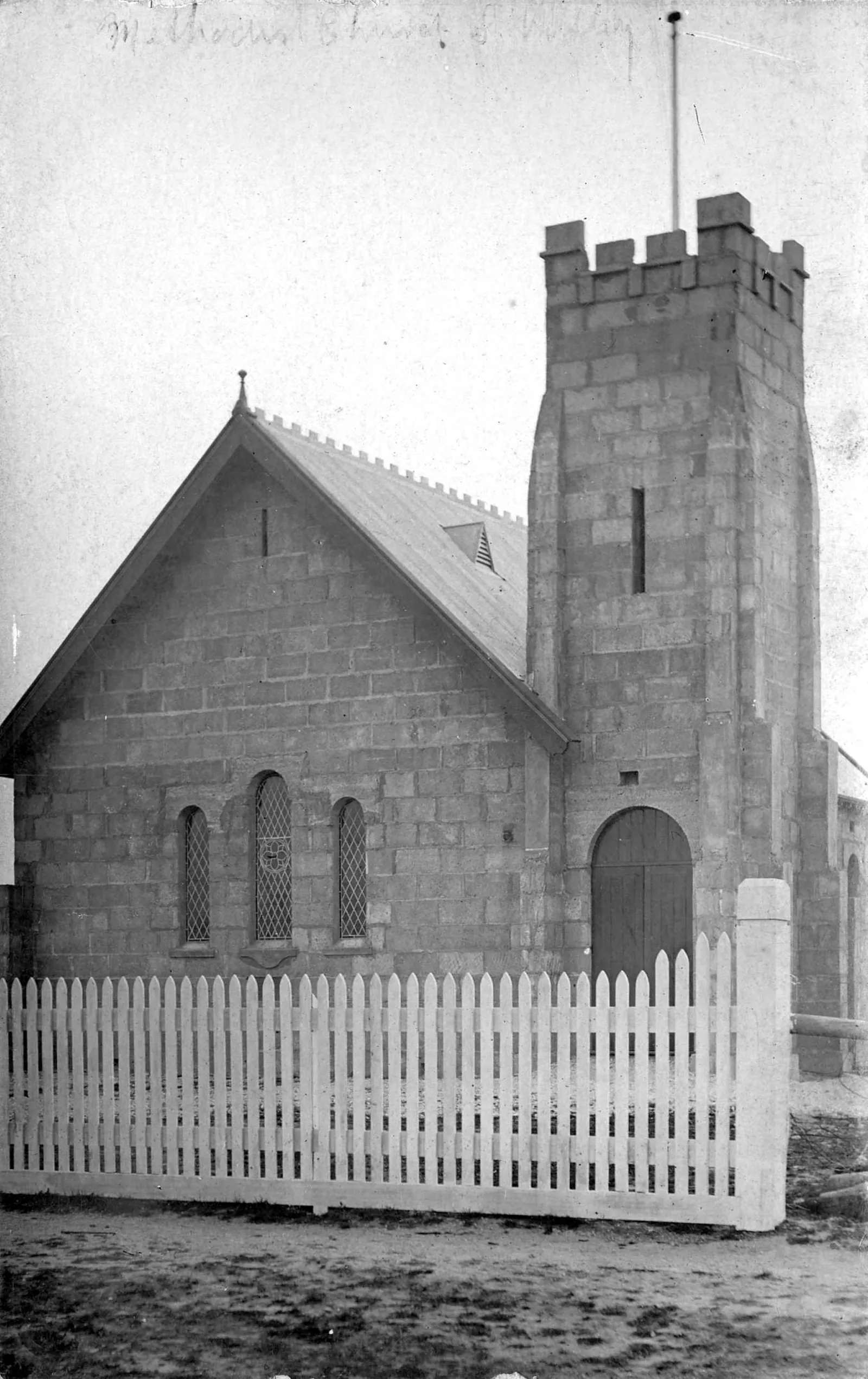
The Methodist church of 1908, about 1914: hollow concrete blocks made on the spot, on the ground where the Welsh had met. State Library Victoria, H96.106/13 From the Ballarat Star, 1 July 1875, the Victorian Heritage Database, Carngham Memorial Church (H2427), the Ballarat Star, 11 November 1884, the Ballarat Star, 27 August 1908 and the Victorian Heritage Database, Former Welsh Methodist Church (H2007).
1878
Three legs and no body
In 1878 the Ballarat Star’s man found three places within three miles: old Carngham, Preston Hill on its rise, and Snake Valley, “a long, dull good mile and a half of road, intersected here and there with stores, shops, publichouses”. Each had its own post office, and they had never agreed where a telegraph office should go. Snake Valley had the court house and the police station, the Camp. “It reminds one of the Manx coat of arms. It has three legs and no body.”
The court had sat as the Carngham Police Court since at least 1858, and by 1878 it sat weekly. The State abolished it from 1 January 1917, and the police station closed in December 1925. Its site is now the Historical Society’s rooms.
On the plan: 6, The court house site; 12, Preston Hill.
Fig. 6
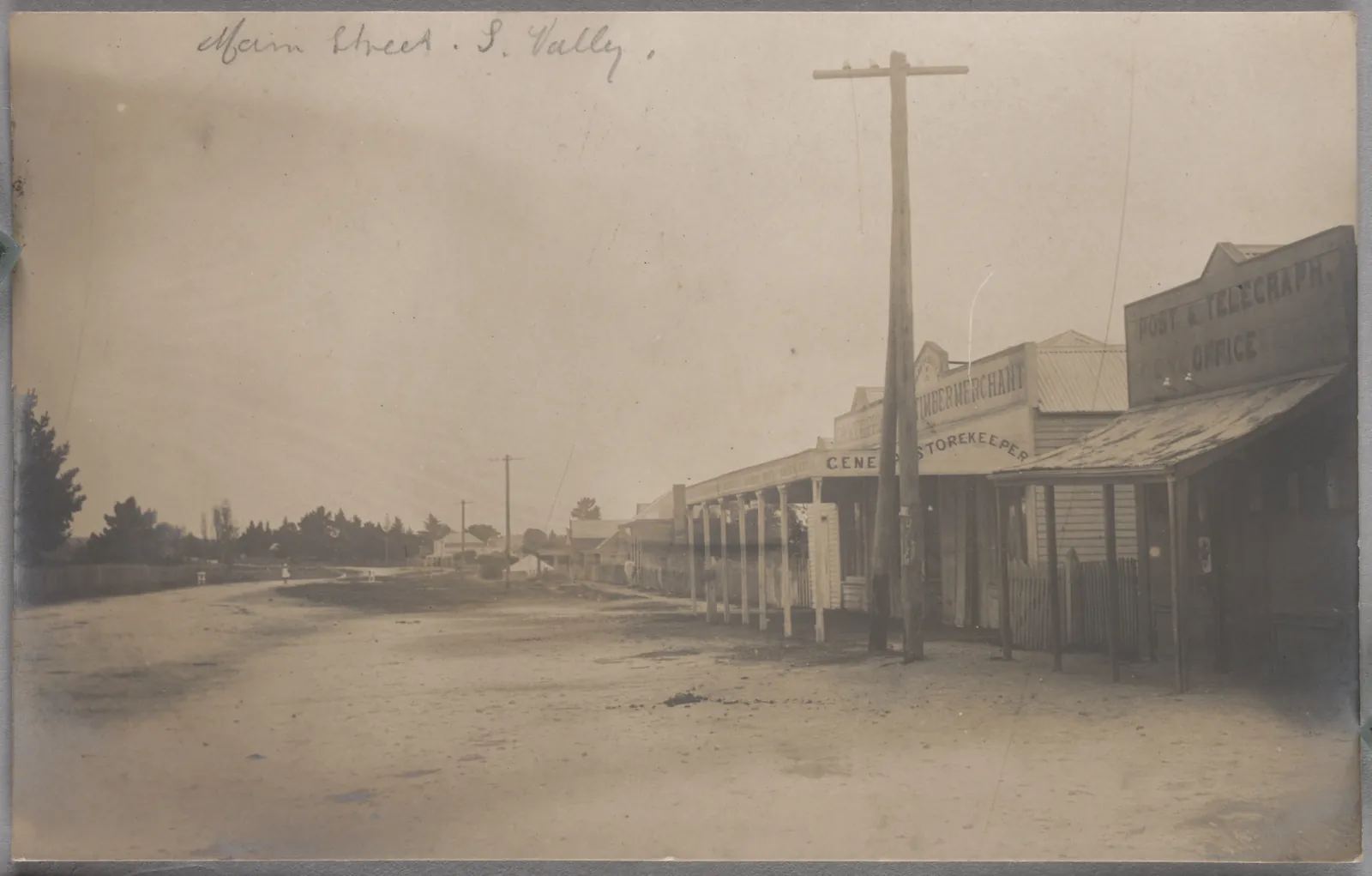
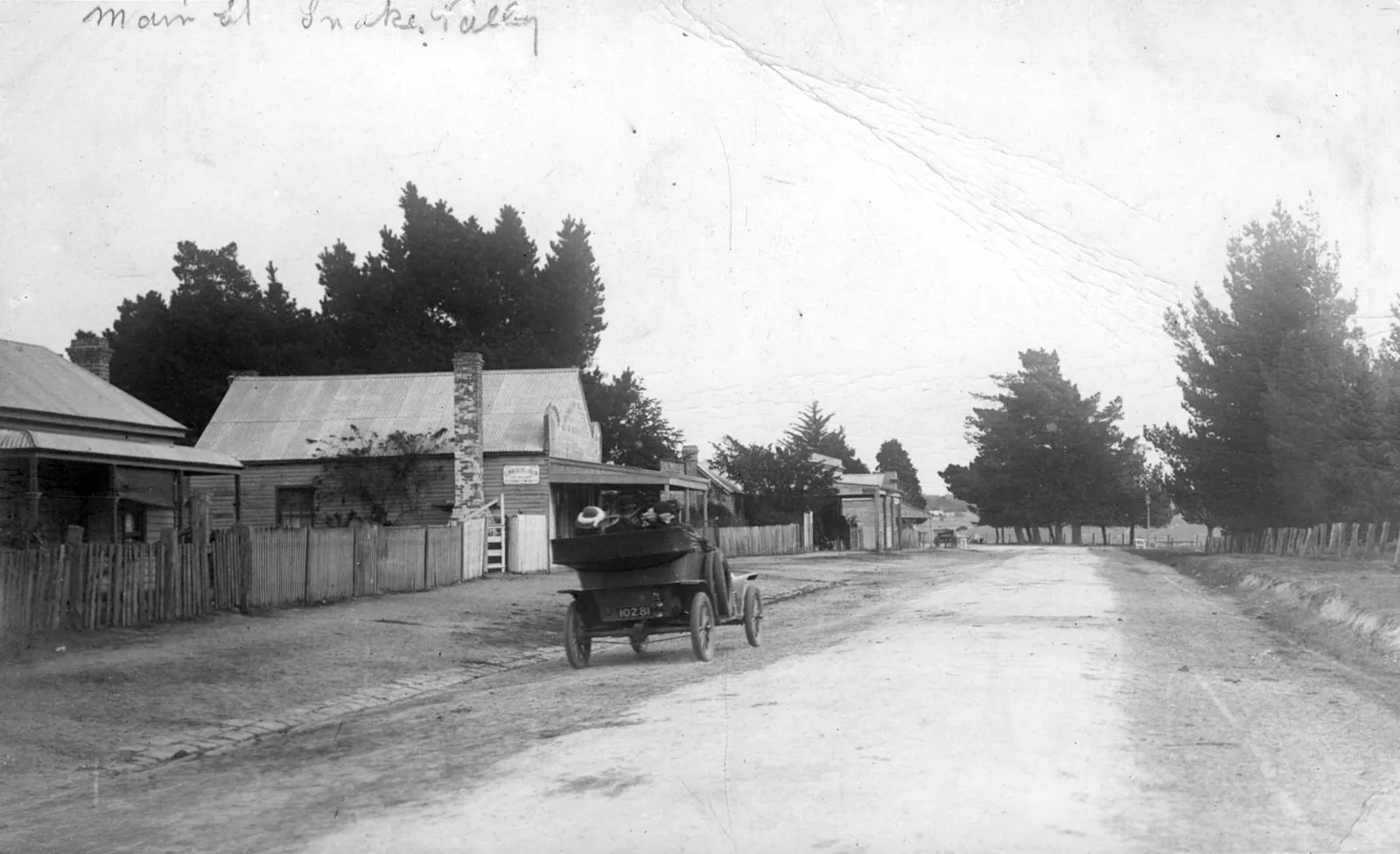
The telegraph came to Snake Valley in the end: the Post & Telegraph Office on Main Street, about 1914. State Library Victoria, H96.106/16 From the Ballarat Star, 26 April 1878, the Star, 4 November 1858, the Star, 19 March 1859, the Riponshire Advocate, 2 December 1916, the Age, 22 December 1925 and the Snake Valley & District Historical Society.
1905
Fire
On Friday 13 January 1905 a fire burnt 20,000 or 25,000 acres of the Russell estate (one report gives both) “from Black Hill to Carngham”. Sixty men rode out to meet it, and worn-out fighters threw themselves into the sheep-wash dam. Had it crossed the creek, “no human efforts could have saved” Snake Valley and Carngham. A bush fire brigade was formed the next January.
On Black Friday, 6 February 1914, charred debris blew over the township from the forest, and only a change of wind kept the fire from the houses. In 2013 a grass fire burnt four homes, and more than a hundred people sheltered in the hall.
From the Grenville Standard, 21 January 1905, the Age, 19 January 1906, the Lismore, Derrinallum and Cressy Advertiser, 11 February 1914 and Wikipedia, Snake Valley, Victoria.
1918
The avenue
In September 1916 Mrs Russell of Carngham, with three sons in France and a fourth in training, gave the district an honour roll for the Mechanics’ reading room. At her request it was unveiled by Mrs J. H. Baxter, whose son had died at Gallipoli.
In June 1918 the school planted a hundred cypresses along its front fence, and that winter the district planted its avenue of honour: 146 golden cypresses by one count and 150 by another, with wattles put in by the older pupils to stand until the cypresses grew. On 24 March 1919 riders and motor cars came down the main road to bring the soldiers home, and the welcome-home nights filled the Mechanics’ Hall “to its utmost”.
Fig. 7
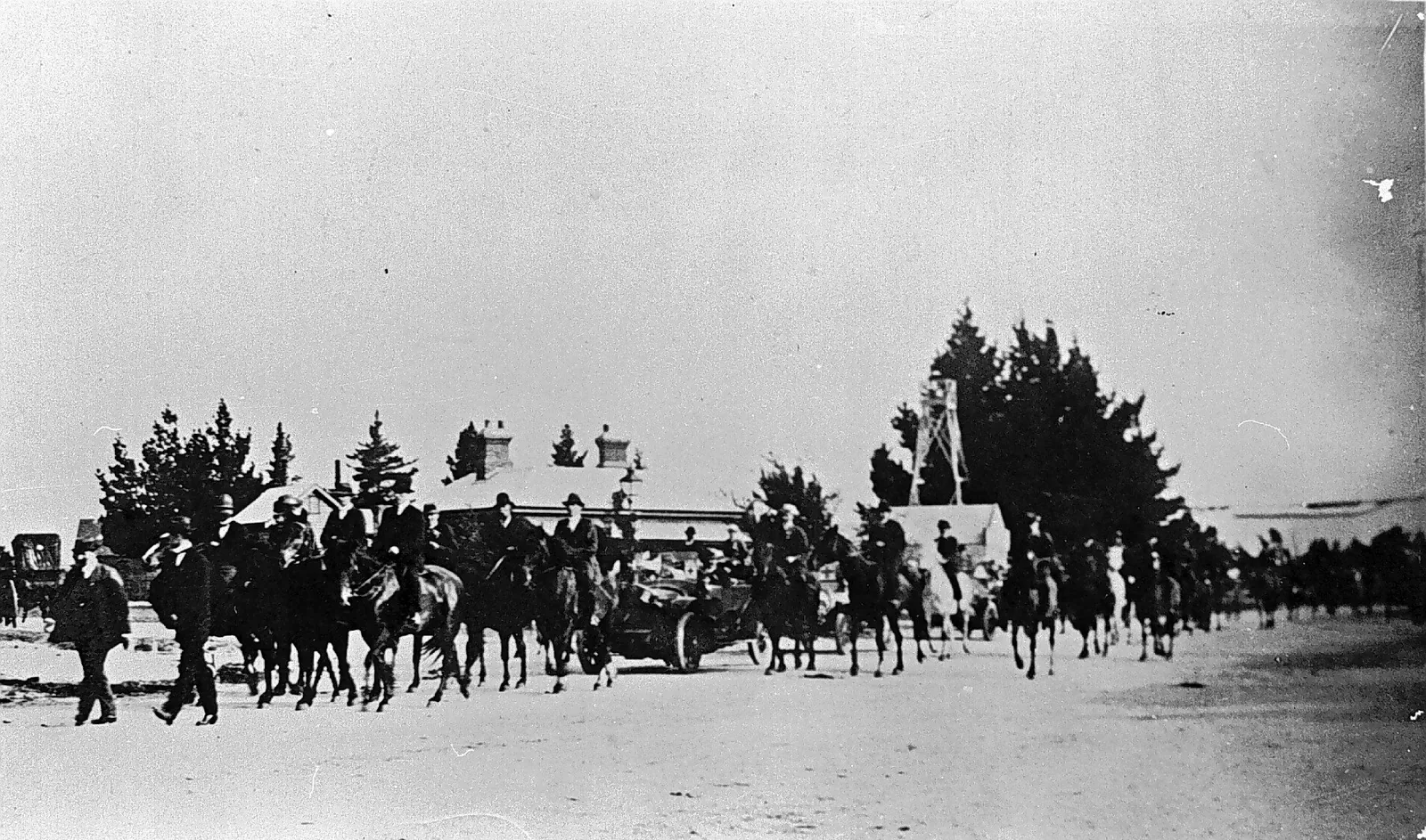
Bringing the soldiers home, 24 March 1919. Animated by AI from the photograph; the movement is ours, not the archive’s. Museums Victoria, MM 1671 From the Riponshire Advocate, 16 September 1916, the Riponshire Advocate, 29 June 1918, the Victorian War Heritage Inventory, Snake Valley Avenue of Honour, the Skipton Standard, 7 September 1918 and the Ballarat Star, 8 April 1919.
1919
Nine hotels, then one
In 1861 the licensing bench granted nine houses across the three places, four of them at Snake Valley: the Britannia, the Grey Horse (or Greyhound), the Snake Valley Hotel and the Man of Kent. The Prince of Wales came later. The Man of Kent was the district’s public room, where the road board met and inquests sat.
The Licences Reduction Board shut the Greyhound and the United States in 1912. In 1919 it had to choose between the last two: the Prince of Wales was the better building, and the Man of Kent stood in the better place. So the Prince of Wales was delicensed and moved onto the Man of Kent’s site, and the joined building, finished in 1921, is the Royal. By 1954 it was “the only hotel”.
On the plan: 7, The Royal.
From the Star, 15 June 1861, the Grenville Standard, 2 March 1912, the Ballarat Star, 21 February 1919, the Argus, 4 March 1919, the Royal Hotel’s own history and the Herald, 16 December 1954.
1926
The new hall
The Mechanics’ Institute had a library by 1870. In June 1926 the new Mechanics’ Hall was opened by Mr Oman, MLA, with a concert by the Lucas Girls’ Company from Ballarat, and it “could not seat the crowd”. It is the hall on the Chepstowe Road corner, and the honour board of 1916 is inside it. That Easter about 140 former residents had come home for Back to Carngham.
On the plan: 8, The hall.
Fig. 8
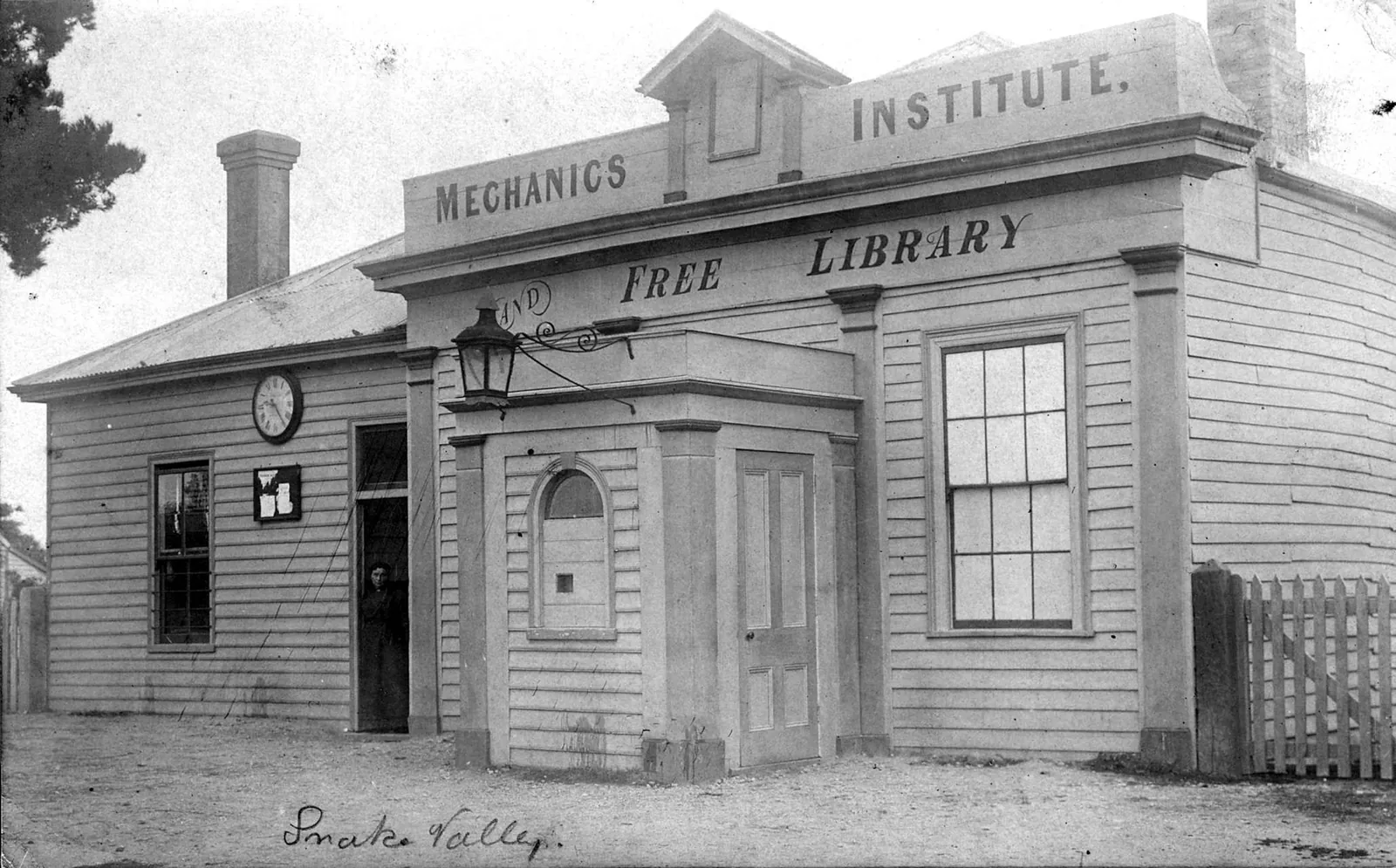
The old Mechanics’ Institute and Free Library, about 1914. State Library Victoria, H96.106/12 From the Ballarat Star, 22 November 1870, the Sun News-Pictorial, 26 June 1926, the Victorian War Heritage Inventory, Snake Valley Hall and Honour Board and the Sun News-Pictorial, 8 April 1926.
2021
Snake Valley now
Between the wars it was farms. In 1933 the Young Farmers’ Club had 44 members raising poultry, sheep and potatoes, and in 1935 a fourteen-year-old wrote that since the grasshopper plague her heifer had gone back, and that Les Greenbank’s flax had done well. In 1954 the Herald found “majestic old pine trees along the wide main street… while old mullock heaps are a reminder of its past glory”.
The town was down to 250 people in 1966 and has grown since. The golf club began in 1960, and the Astronomical Association in 2005; its dark sky was rated gold in 2015. The school became a campus of Woady Yaloak Primary in 1994. At the 2021 Census, 820 people lived in the Snake Valley locality, which reaches well beyond the town.
Fig. 9
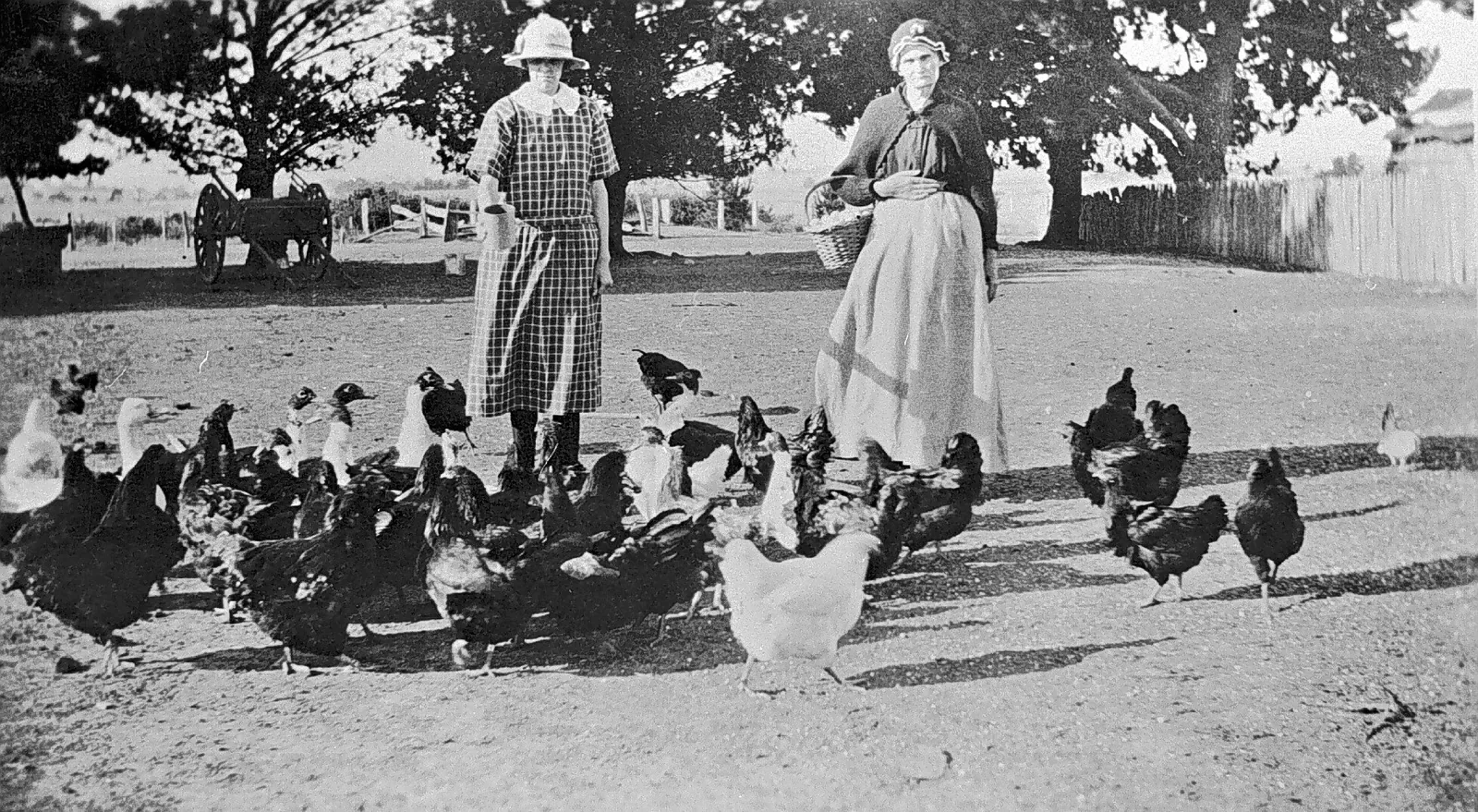
Agnes and Lillian Wilson feeding the fowls at Snake Valley, about 1925. Animated by AI from the photograph; the movement is ours, not the archive’s. Museums Victoria, MM 2003 From the Weekly Times, 9 September 1933, the Weekly Times, 23 March 1935, the Herald, 16 December 1954, Victorian Places, Snake Valley, Wikipedia, Snake Valley Astronomical Association, the Department of Education, Snake Valley Primary School No. 574 and ABS 2021 Census QuickStats, Snake Valley.
Where it happened
Snake Valley as it lies now, from OpenStreetMap, with the buildings in grey: the Linton–Carngham Road runs down the middle, and the town is where the Smythesdale and Chepstowe roads meet it. The deep lead ran south down the valley from the town, and its claims are the numbers at the bottom. The stores of 1857, the old hotels, the first school and the Chinese miners’ huts cannot be placed.
1. The Prince of Wales. At the south end of the Snake Valley Lead: its mullock heaps, and three horse puddlers 140 metres south-west.
2. The Great Britain and the Sherwood. Two of the claims leased along the lead by 1859.
3. The Red Lion. “Bottomed, and doing well”, with an engine, in 1859.
4. The Britannia. The quartz mine, Coates Road: four men killed in 1861; the Carngham Star by 1935.
5. The school. School No. 574, now a Woady Yaloak campus. Where the first school of 1854 stood is not known.
6. The court house site. The Camp, with the police station. Now the Historical Society’s rooms; the exact lot is the Society’s word.
7. The Royal. The Man of Kent’s site, with the Prince of Wales moved onto it in 1919.
8. The hall. The new Mechanics’ Hall of 1926, with the honour board.
9. Holy Trinity. Its stone laid in 1875, “having a frontage to the main street”.
10. The Methodist church. Of 1908, on the ground of the Welsh chapel.
11. Carngham Memorial Church. Philip Russell’s bequest, 1893. Now the Uniting church.
12. Preston Hill. The second of the “three legs”, on its rise. Where old Carngham stood, the third, is not known.
Snake Valley now
Checked 1 October 2026. Something missing, closed or wrong? Write to hello@onelobster.au
The Royal Hotel
Pub · 886 Linton–Carngham Road
Pizza and trivia on Tuesday, parmas on Thursday, the Joker drawn on Friday, and five rooms upstairs.
(03) 5344 9224theroyalsnakevalley@
gmail.comroyalhotelsnakevalley.com.au General store and post office
Shop and Australia Post · 865 Linton–Carngham Road
The town’s shop, with the post office counter and PO boxes inside.
Post office Monday to Friday 7am–6pm · Saturday 7am–12pm
Camp Wedgetail
Group camp · 554 Linton–Carngham Road, 3 km south
Cabins on eleven acres with a five-acre lake, hired to groups, and a boys’ summer camp every January.
Snake Valley & District Rural Fire Brigade
CFA · Next to the school
The volunteer fire brigade. In an emergency ring 000.
Woady Yaloak Primary School
School · Snake Valley campus, 999 Smythesdale–Snake Valley Road
One of four campuses, with Ross Creek, Scarsdale and Smythesdale.
(03) 5342 8565woady.yaloak.ps@
education.vic.gov.auwoadyyaloak.vic.edu.au Mobile library
Library · Visits the town; the shire doesn’t say where it stops
Pyrenees Libraries’ van, with the whole Central Highlands catalogue to order from.
Fortnightly: Tuesdays 2–3.30pm and alternate Wednesdays 2–4pm, on the dates in the shire’s timetable
C27 bus
Transport · Snake Valley to Smythesdale, Haddon and Delacombe
Mondays, Wednesdays and Fridays to Delacombe Town Centre. From Snake Valley it runs on demand: book by 5pm the day before, and Transport Victoria’s line will tell you how. Coming home in the afternoon, tell the driver you’re going on to Snake Valley.
Carngham Uniting Church
Church · 954 Linton–Carngham Road
The bluestone church of 1893, with its stained glass and a heritage-listed organ. A congregation still meets, and it is hired for weddings and events.
0407 847 488carnghamunitingchurch@
gmail.comcarnghamchurch.com.au Carngham Uniting Church Op Shop
Op shop · Behind the church, 954 Linton–Carngham Road
Second-hand clothes, books and homewares in the old Sunday School rooms. Go in at the back.
Saturday 10am–1pm
St Brigid’s Catholic Church
Church · 870 Linton–Carngham Road
Part of Holy Trinity Parish, with Linton, Redan, Sebastopol and Skipton.
Saturday vigil Mass 6.30pm (check the parish notice sheet)
southwestballarat@
ballarat.catholic.org.auballarat.catholic.org.au Holy Trinity Anglican Church
Church · Linton–Carngham Road
Anglican, in the Parish of Beaufort and Skipton. Ring the parish for service times.
Snake Valley & District Historical Society
Society · 1019 Smythesdale–Snake Valley Road
The district’s photographs, records and the quarterly District Diggings, in the rooms on the site of the old courthouse. Members meet the second Tuesday of the month at 7.30pm.
By appointment
Snake Valley Observatory
Astronomy club · 825 Linton–Carngham Road
The Snake Valley Astronomical Association’s observatory, built by its members under a gold-rated dark sky. No public nights in 2026 while building work goes on; they hope to reopen in 2027.
Carngham Linton Football Netball Club
Club · Carngham Recreation Reserve, Chepstowe Road
The Saints: football and netball in the Central Highlands league, with home games split between here and Linton.
Snake Valley Golf Club
Golf · Snake Valley–Chepstowe Road, 3 km west
Nine holes played twice off different tees, $20 for eighteen. Competition is on Sundays, and the tee-off time goes up on their Facebook the day before.
Snake Valley Supported Playgroup
Playgroup · Snake Valley Hall, 875 Linton–Carngham Road
The shire’s playgroup for families with young children.
Fridays 10am–12pm in school terms
Snake Valley Hall
Community hall · 875 Linton–Carngham Road, at the Chepstowe Road corner
The hall of 1926 with the First World War honour board inside, and a fenced playground, barbecue and tables beside it.
Carngham Recreation Reserve
Reserve · 73 Chepstowe–Snake Valley Road
The oval, netball court and cricket nets, where the Saints play their Snake Valley home games and the swap meet is held each February. Also called the Snake Valley Recreation Reserve.
Carngham Bushland Reserve
Bush · South-west of the town
A Parks Victoria bushland reserve on the town’s south-western edge.
Carngham Cemetery
Cemetery · Cemetery Hill Road, Carngham, 4.6 km north
The district’s cemetery, kept by a volunteer trust. Its burial records are being digitised.
To read more
The Snake Valley & District Historical Society publishes District Diggings, its local history newsletter, four times a year, and in July 2026 Snake Valley & District: Signs & Plaques, by Joan Wilson and Pat Yeoman, the stories behind the district’s monuments, memorials, churches and landmarks. Copies are at the general store, or write to the Society.
Sources
Everything above was read on 1 October 2026. Where two sources disagree, the page says so.
- Wadawurrung Traditional Owners Aboriginal Corporation
- Victorian Places, Snake Valley
- Wikipedia, Snake Valley, Victoria
- Pyrenees Shire Council, Safer and more resilient Pyrenees Communities: Snake Valley (2019)
- The Port Phillip Gazette, 9 September 1840
- The Victorian Heritage Database, Carngham Memorial Church (H2427)
- Victorian Places, Carngham
- The Argus, 31 March 1853
- The Star, 22 October 1857
- The Star, 23 November 1857
- The Border Post, 5 December 1857
- The Mount Ararat Advertiser, 27 November 1857
- The Star, 3 December 1857
- The Star, 11 December 1857
- The Star, 13 May 1858
- The Argus, 23 September 1859
- The Heritage Inventory, Prince of Wales Company
- State Library Victoria, H6866
- The Argus, 19 July 1859
- The Geelong Advertiser, 23 March 1861
- The Star, 9 April 1861
- The Heritage Inventory, Britannia Company
- The Ballarat Star, 28 December 1866
- The Ballarat Star, 8 December 1868
- The Ballarat Courier, 3 January 1918
- The Department of Education, Snake Valley Primary School No. 574
- The Ballarat Star, 27 December 1870
- The Mount Alexander Mail, 28 December 1864
- The Argus, 24 February 1857
- The Leader, 16 December 1865
- The Ballarat Star, 4 June 1866
- The Ballarat Star, 20 July 1866
- The Argus, 19 February 1879
- The Ballarat Star, 1 July 1875
- The Ballarat Star, 11 November 1884
- The Ballarat Star, 27 August 1908
- The Victorian Heritage Database, Former Welsh Methodist Church (H2007)
- The Ballarat Star, 26 April 1878
- The Star, 4 November 1858
- The Star, 19 March 1859
- The Riponshire Advocate, 2 December 1916
- The Age, 22 December 1925
- The Snake Valley & District Historical Society
- The Grenville Standard, 21 January 1905
- The Age, 19 January 1906
- The Lismore, Derrinallum and Cressy Advertiser, 11 February 1914
- The Riponshire Advocate, 16 September 1916
- The Riponshire Advocate, 29 June 1918
- The Victorian War Heritage Inventory, Snake Valley Avenue of Honour
- The Skipton Standard, 7 September 1918
- The Ballarat Star, 8 April 1919
- The Star, 15 June 1861
- The Grenville Standard, 2 March 1912
- The Ballarat Star, 21 February 1919
- The Argus, 4 March 1919
- The Royal Hotel’s own history
- The Herald, 16 December 1954
- The Ballarat Star, 22 November 1870
- The Sun News-Pictorial, 26 June 1926
- The Victorian War Heritage Inventory, Snake Valley Hall and Honour Board
- The Sun News-Pictorial, 8 April 1926
- The Weekly Times, 9 September 1933
- The Weekly Times, 23 March 1935
- Wikipedia, Snake Valley Astronomical Association
- ABS 2021 Census QuickStats, Snake Valley
- State Library Victoria, H96.106/11
- Museums Victoria, MM 692
- State Library Victoria, H96.106/17
- State Library Victoria, H96.106/13
- State Library Victoria, H96.106/16
- Museums Victoria, MM 1671
- State Library Victoria, H96.106/12
- Museums Victoria, MM 2003